Technique
Learn Muay Thai Techniques: All 8 Weapons With Pictures
See every Muay Thai technique by family with its Thai name, one cue and the IFMA scoring note, plus diagrams. Save the page as a PDF for the gym.
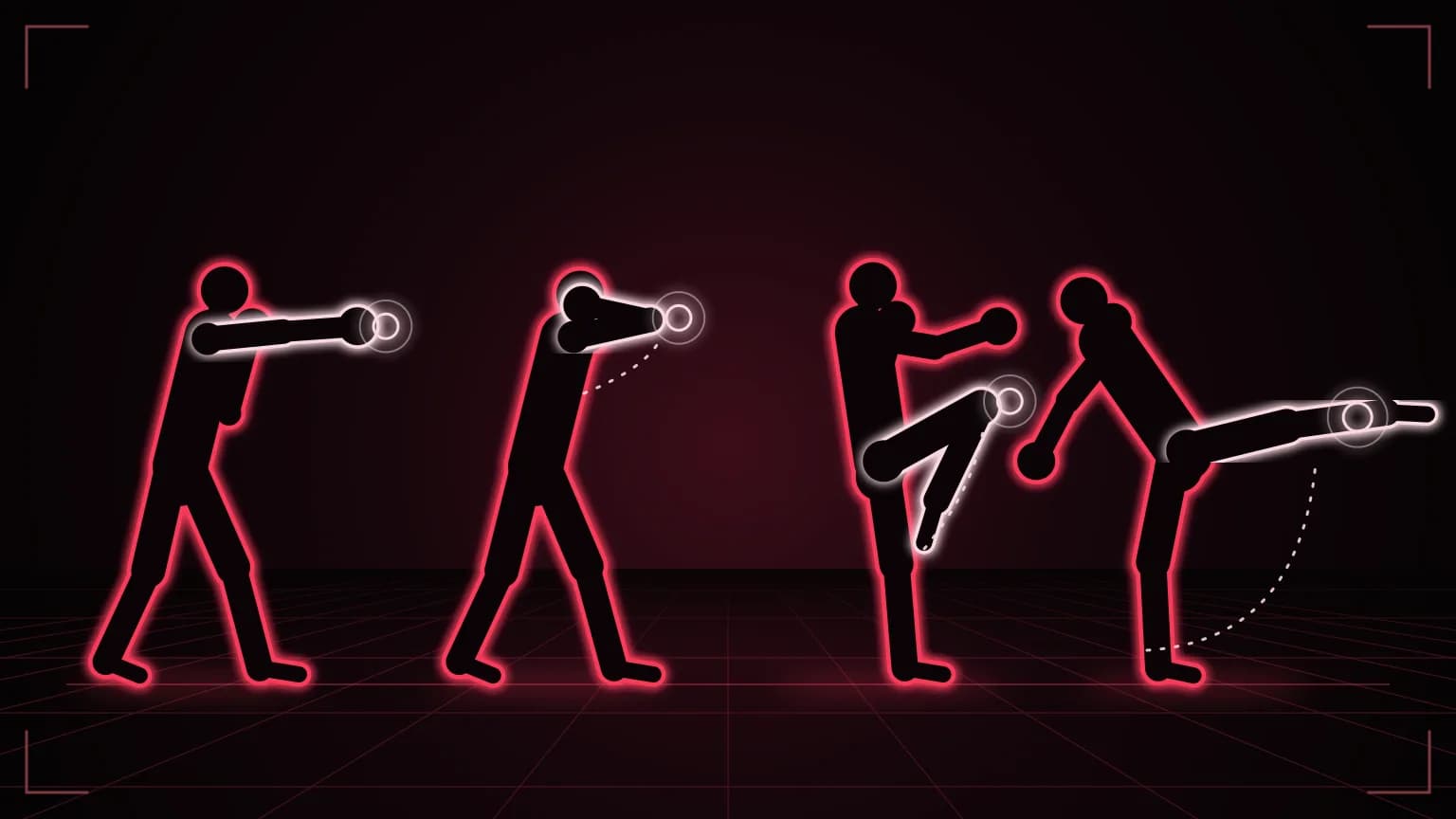
Muay Thai techniques fall into eight families: punches (mat), elbows (sok), knees (khao), kicks (te), teeps (thip), the clinch, sweeps and defense. You fight with eight weapons, two fists, two elbows, two knees and two shins, and under IFMA rules every punch, kick, knee or elbow that lands with force on a target without a block counts as one score.
Below you get every core technique in a table with its Thai name, one cue you can take to the bag tonight and the scoring note from the rulebook, plus two diagrams. Want it on paper? Press Ctrl+P on Windows or Cmd+P on a Mac and pick Save as PDF.
See the eight weapons on one fighter
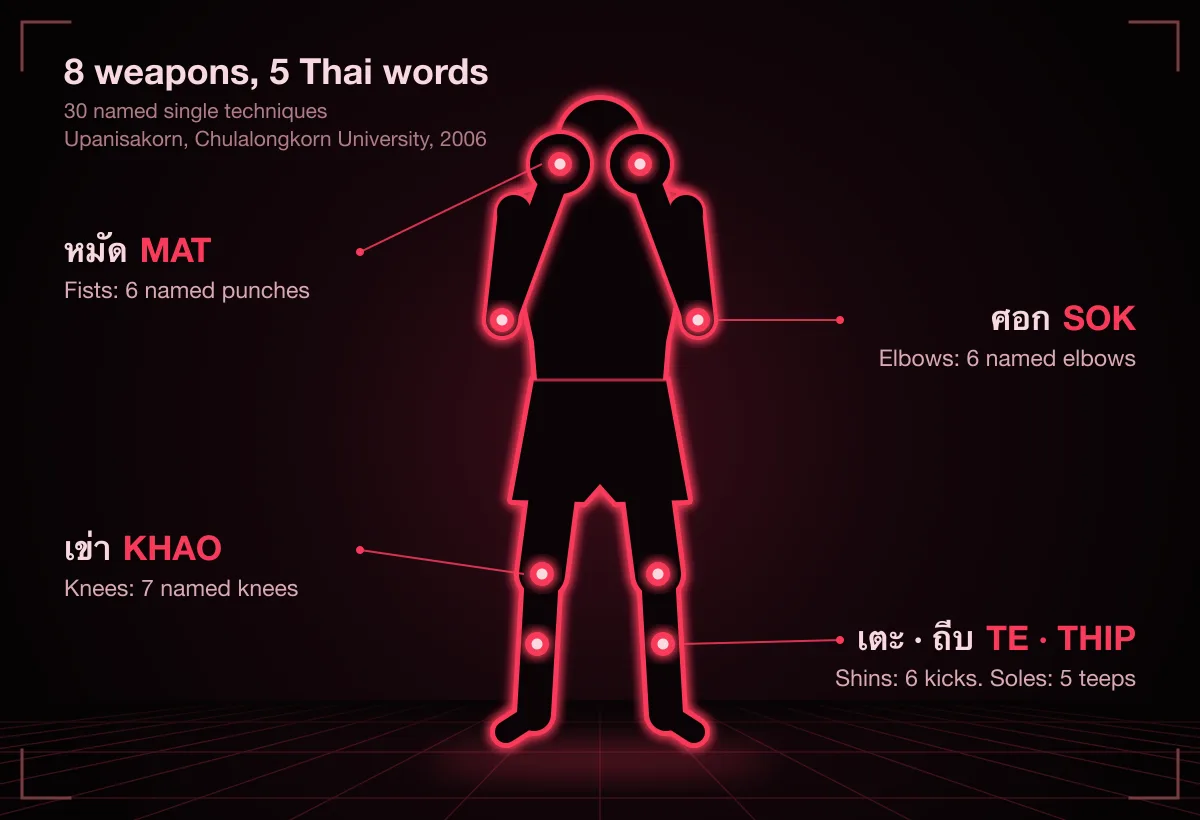
A 2006 Chulalongkorn University thesis collected the names Thai boxers and teachers give their techniques. It found five basic words: หมัด (mat, fists), ศอก (sok, elbows), เข่า (khao, knees), เตะ (te, kicks) and ถีบ (thip, a kick with the sole, the teep you know). Under them it counted 30 single techniques, plus 87 complex ones with names such as "a deer looks back" (Upanisakorn, 2006).
| Family | Thai word | Named single techniques | What lands |
|---|---|---|---|
| Punches | หมัด mat | 6 | Your knuckles, inside the glove |
| Elbows | ศอก sok | 6 | The point and the edge of your elbow |
| Knees | เข่า khao | 7 | The point of your knee |
| Kicks | เตะ te | 6 | Your lower shin, sometimes the instep |
| Teeps | ถีบ thip | 5 | The ball or the sole of your foot |
The clinch, sweeps and defense add no new weapon. They decide when your eight weapons land. Romanized spellings change from camp to camp, so learn the Thai script when your kru uses it.
Know what scores before you drill
Drill the version of a technique that scores. IFMA Rule 29.1 counts a punch, kick, knee or elbow thrown with force and intent as a Muaythai skill, and gives one score for each one that lands on a scoring target without a block.
- Your target is any part of the body except the groin and the back of the neck, from C1 to C7 plus the occipital bone (Rule 29.1.1).
- A strike on the gloves, forearms, feet or shins scores nothing, unless it moves your opponent, such as a high kick into the gloves that knocks them off balance (Rule 29.1.2).
- A throw without a strike scores nothing (Rule 29.2.2).
- The count decides the round. Land 1 to 7 more scoring skills than your opponent for a 10-9 round, 8 to 14 more for 10-8 and 15 to 21 more for 10-7. On a tied count, the more forceful skills win (Rule 29.2).
Pro rules agree. WMC Rule 14.1 rewards fists, feet, knees and elbows that hit powerfully, accurately and unprotected, and Rule 14.3.2 gives nothing for a strike on an arm or leg raised in defense.
Your age decides which weapons you may throw at an IFMA event (Rule 31.3):
| Division | What you may not throw |
|---|---|
| Masters, Elite, U24, U18 and U16 | No restriction |
| U14 | Elbows or knees to the head |
| U12, U10 and U8 | Any strike to the head |
Throw the punches (mat)
Thai boxers punch from a taller stance than boxers, with the weight ready to kick, so keep every punch short and bring it straight back to your face.
| Technique | Thai name | Your cue | Scoring note |
|---|---|---|---|
| Jab | หมัดแย็บ mat yaep | Snap the lead hand out and back, rear glove on your cheek | A jab into the gloves scores nothing |
| Straight or cross | หมัดตรง mat trong | Turn your rear heel and hip together, land with the first two knuckles | Scores on the face and body |
| Hook | หมัดฮุก mat huk | Keep the elbow at fist height and turn your whole torso | A hook to the back of the head counts as a foul (Rule 31.2.18) |
| Uppercut | หมัดเสย mat soei | Dip your knees, then drive up through the gap in their guard | Lands best as they break from the clinch |
| Spinning backfist | หมัดเหวี่ยงหลัง mat wiang lang | Turn your head first, strike with the back of the glove | A miss shows your back, so throw it off a feint |
The thesis lists a sixth punch, หมัดค้ำ (mat kham), which it glosses as a defended punch. In a study of 32 five-round fights, the winners threw 22.28 punches each per fight, second only to body kicks (Myers and colleagues, 2013).
Cut with the elbows (sok)
Elbows work inside punching range. Step in until your forearm touches their guard, then strike.
| Technique | Thai name | Your cue | Scoring note |
|---|---|---|---|
| Side elbow | ศอกตัด sok tat | Swing it level across the target, like a hook with a shorter arm | Scores on the face and body |
| Circular elbow | ศอกตี sok ti | Bring the elbow around on a round path at head height | IFMA U14 bans elbows to the head |
| Uppercut elbow | ศอกงัด sok ngat | Drive the point straight up between their gloves | Splits a high guard |
| Downward elbow | ศอกสับ sok sap | Lift the elbow above your head and chop down onto the brow | Lands as they duck in |
| Reverse elbow | ศอกกลับ sok klap | Step across, turn your head first, whip the elbow back around | A miss shows your back |
The thesis adds ศอกกระทุ้ง (sok krathung), a backward elbow you will rarely see in the ring. Keep elbows light in sparring, since they open cuts. The Muay Thai elbow techniques guide walks you through five elbow paths with pad drills.
Drive the knees (khao)
Knees win the clinch. Hold your posture, push your hips forward and point the knee through the target.
| Technique | Thai name | Your cue | Scoring note |
|---|---|---|---|
| Straight knee | เข่าตรง khao trong | Pull their guard or neck down and thrust your hips forward | Head shots only from U16 up |
| Diagonal knee | เข่าเฉียง khao chiang | Drive the knee in on a 45 degree line to the ribs | Lands from the side clinch |
| Side knee | เข่าตัด khao tat | Lift the knee sideways and cut it across | Hits the thigh or ribs |
| Curved knee | เข่าโค้ง khao khong | Swing the knee around from outside to the ribs | The thesis calls it a slope knee |
| Skipping knee | เข่าเด้ง khao deng | Skip forward on the standing foot as the knee rises | Closes distance in one step |
| Flying knee | เข่าลอย khao loi | Jump off the rear leg and drive the knee up, hands high | High risk if they step back |
| Double straight knee | เข่ายัด khao yat | Fire two straight knees from one grip | Keeps them bent over |
A knee to the groin counts as a foul under IFMA Rule 31.2.18 and WMC Rule 15.6. The winners in the Myers study threw 14.09 knees each per fight, and Thai winners threw 11.0 more per bout than UK winners. The Muay Thai knee strikes guide covers the hip action and safe clinch drills.
Kick with the shin (te)
Land your kicks with the lower third of your shin. Step out at an angle, turn your standing heel toward the target and swing the hip through.
| Technique | Thai name | Your cue | Scoring note |
|---|---|---|---|
| Round kick, body | เตะตัด te tat | Turn the standing heel, swing the shin through the ribs | A kick into a raised shin scores nothing |
| Round kick, leg | เตะตัด te tat, low | Aim the shin at the outer thigh, above the knee | Lands best as they put weight on that leg |
| Round kick, head | เตะตัด te tat, high | Lean back and turn the hip all the way over | Into the gloves, it scores only if it moves them |
| Diagonal kick | เตะเฉียง te chiang | Drive the kick up on a 45 degree line under the arm | Gets under a high guard |
| Front kick | เตะตรง te trong | Snap the instep or ball of the foot straight up | Fast, light, easy to catch |
| Flicking kick | เตะดีด te dit | Flick the instep up from a bent knee | Scores only with force behind it |
| Downward kick | เตะฟาด te fat | Chop the shin down on a steep arc | Lands on the thigh or shoulder |
| Spinning kick | เตะเหวี่ยงหลัง te wiang lang | Spot the target over your shoulder before the leg leaves | A miss shows your back |
Your hip drives the round kick. In a 3D motion study of 47 athletes, the 15 Muay Thai fighters kicked from a shorter distance than the taekwondo and karate athletes and reached a higher peak hip angular velocity than both (Diniz and colleagues, 2021). The body and neck round kick also topped the Myers count at 26.03 per fighter per fight. The Muay Thai roundhouse kick guide teaches the pivot, guard and recovery.
Push with the teep (thip)
The teep holds your distance and breaks your opponent's rhythm. Lift the knee first, then push the ball of the foot through the target with your hips.
| Technique | Thai name | Your cue | Scoring note |
|---|---|---|---|
| Front teep | ถีบตรง thip trong | Knee to your chest, then drive the ball of the foot into the belly | A teep counts as a kick, so it scores with force |
| Side teep | ถีบข้าง thip khang | Turn side-on and push the sole into the hip or ribs | Stops a forward step |
| High teep | ถีบสูง thip sung | Push the sole up to the chest | Easy to catch, so retract fast |
| Backward teep | ถีบหลัง thip lang | Turn and drive the sole straight back | Your back faces them for a moment |
| Toe-pick teep | ถีบจิก thip chik | Point the toes into the solar plexus | Drill it slowly on a soft bag first |
The winners in the Myers study threw 16.75 teeps each per fight, and Thai winners threw 15.4 more per bout than UK winners. The teep guide compares the lead and rear teep and shows you how to recover.
Control the clinch
The clinch gives your knees and elbows a target that cannot step away. Start with three positions:
| Position | Your hands | What you throw |
|---|---|---|
| Double collar tie | Both hands stacked behind their head, elbows squeezed in | Straight knees to the body and head |
| Single collar tie | One hand behind the head, one on their biceps | Diagonal knees and a turn to off-balance them |
| Arm control | Both hands on their biceps or wrists | Knees while they cannot frame on your hips |
The referee breaks a clinch with "YAEK", and you step back (IFMA Rule 26.3). Holding scores nothing. Catch a leg and push more than two steps without a strike and you commit a foul under IFMA Rule 31.2.19, WMC Rule 15.7 and the ABC unified rules, and IFMA calls lifting an opponent by the body or locking a joint a foul too (Rules 31.2.9 and 31.2.10).
The winners in the Myers study clinched to attack 15.97 times each per fight. The Muay Thai clinch basics guide builds your posture and inside position step by step.
Sweep and dump inside the rules
Drill two sweeps first: the catch and sweep, where you catch a round kick and take out the standing leg, and the clinch dump, where you turn their shoulders and step across.
- Kick the leg out. The ABC unified rules let you kick an opponent off their feet with the top of your foot or the front of your shin.
- Keep your heel off their leg. IFMA Rule 31.2.8 calls hooking or trapping a leg with your calf, ankle or heel a foul.
- Strike as you sweep. IFMA Rule 31.2.7 calls a trip without a Muaythai skill, a hip throw and a tackle fouls, and Rule 29.2.2 and WMC Rule 14.3.5 give nothing for a throw without a strike.
The Myers winners threw 2.69 legal throws each per fight, a small number next to their kicks. The Muay Thai sweeps guide teaches both sweeps and their timing.
Defend every family
Make every attack land on gloves, forearms or shins, since IFMA Rule 29.1.2 scores none of those strikes.
| Their attack | Your defense | Your counter |
|---|---|---|
| Jab and cross | Parry, slip or extend a long guard | Rear round kick as they reset |
| Hook | Glove to your ear, elbow tight | Elbow inside their next hook |
| Round kick, body or leg | Check: lift your shin to meet it | Kick back on the same side |
| Teep | Scoop it aside or step off the line | Round kick to the open leg |
| Knees in the clinch | Frame on their hips and turn them | Your own knee as they lose posture |
| Elbows | Cover high, or step out of range | Teep to reset the distance |
Thai winners in the Myers study caught their opponent's leg far more often than UK winners, and all winners threw almost three times more attacks than defensive techniques. Defend to set up your next attack.
See what winners throw in a real fight
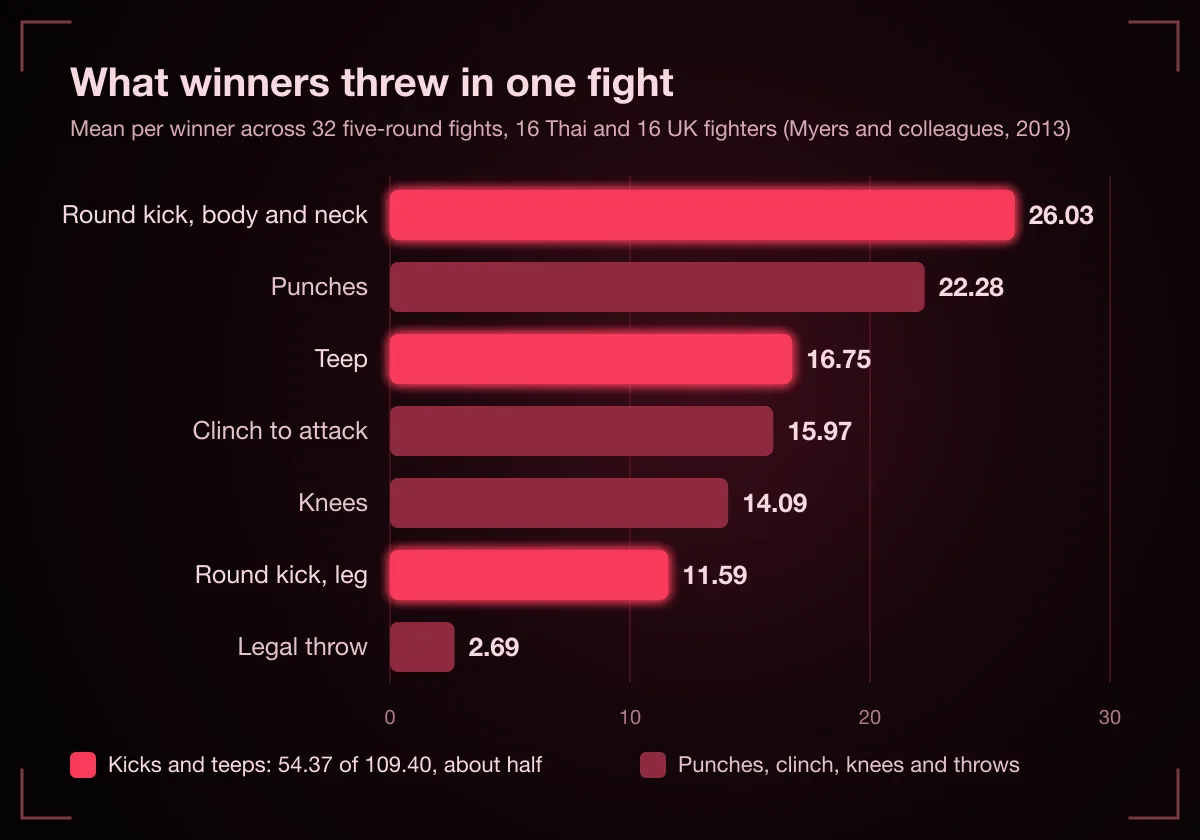
Myers and colleagues coded the winners of 32 five-round fights, 16 Thai and 16 UK fighters, every round 3 minutes long. Thai winners threw 124.06 attacking techniques per fight against 96.56 for UK winners.
Add the three kicking bars, 26.03, 16.75 and 11.59, and you get 54.37 of the 109.40 techniques in the chart: about half of everything these winners threw. My reading: give kicks and teeps about half your technique rounds. The authors give no training split, the sample holds 32 winners, and the study reports no separate count for elbows, so use the numbers as a guide.
Learn them in this order
| Weeks | Add these | Why |
|---|---|---|
| 1 to 4 | Stance, jab, cross, front teep, round kick to body and leg, the check | The most thrown weapons in the Myers count, plus the block for the kick |
| 5 to 8 | Hook, uppercut, straight and diagonal knees, side elbow | Close-range weapons, drilled on pads before you spar with them |
| 9 to 12 | Collar ties, the catch and sweep, kick counters | Weapons that need a reaction from your partner |
Your coach will move rows around for your body and your gym, and children follow the IFMA limits in the table above.
Give each family its own round. Set 3-minute rounds with 1 minute of rest, the rhythm of an IFMA Elite bout, in the Muay Thai round timer, then work one family per round: punches, kicks, teeps, knees. For a stadium fight, Lumpinee runs up to 5 rounds of 3 minutes with 2-minute intervals, and the timer loads that preset too.
Fix the mistakes that waste your strikes
- You land round kicks with the foot. Turn your hip over and aim the lower third of your shin through the target.
- Your guard drops when you kick. Swing the kicking-side arm down for balance and keep the other glove at your chin.
- Your teep pushes with the leg alone. Lift the knee to your chest first, then drive your hips forward.
- You throw elbows from punching range. Step in until your forearm touches their guard.
- You hold the clinch and wait. Strike within a beat or two of locking your grip, before the referee calls "YAEK".
- You sweep with your heel. Kick the standing leg with your shin or the top of your foot.
Train the techniques safely
Most Muay Thai injuries hit the legs. In interviews with 152 fighters in the UK and the Netherlands, lower limb injuries came first in every group, and beginners reported the highest yearly rate: 13.5 per 1,000 participants against 2.43 for amateurs and 2.79 for professionals (Gartland and colleagues, 2001).
Fights add risk. In a survey of 195 fighters, 55.4% reported an injury in their most recent fight, 58% of those injuries hit the arms or legs, and fighters who wore protective equipment had lower odds of injury, with an odds ratio of 0.46 (Strotmeyer and colleagues, 2016). Both studies rely on what fighters remember, so treat the numbers as estimates.
- Wear shin guards and a mouthguard in every sparring round.
- Spar elbows and knees at light contact, after you drill them on pads.
- After a hit to the head with symptoms, stop. The CDC tells you to remove an athlete from sport right away and keep them out until a healthcare provider clears them.
- See a physician for joint pain that lasts more than a few days.
Get quick answers
What are the 8 weapons of Muay Thai?
Your two fists, two elbows, two knees and two shins. Thai camps name the strikes with five words: mat for punches, sok for elbows, khao for knees, te for kicks and thip for teeps.
How many techniques are there in Muay Thai?
A 2006 Chulalongkorn University thesis counted 30 single techniques under those five words, plus 87 complex techniques with names such as "a deer looks back".
Which Muay Thai technique scores the most?
Under IFMA rules every scoring punch, kick, knee or elbow counts once, and force breaks a tie. Under WMC rules heavier, more accurate strikes earn the advantage. The winners in the Myers study threw the body and neck round kick most: 26.03 times each per fight.
Do sweeps score in Muay Thai?
Not on their own. IFMA Rule 29.2.2 and WMC Rule 14.3.5 give nothing for a throw without a strike, so land a knee or a kick as you sweep.
Can I get Muay Thai techniques as a PDF?
Yes. Press Ctrl+P or Cmd+P on this page and choose Save as PDF to keep the tables and both diagrams for the gym.
Check the sources
- IFMA Muaythai Rules and Regulations, revised May 11, 2026
- WMC Rules and Regulations for Competitions, 2026
- ABC Unified Rules of Professional Muay Thai, July 2024
- Lumpinee Boxing Stadium: About Muay Thai
- Upanisakorn, Chulalongkorn University thesis, 2006, DOI 10.58837/CHULA.THE.2006.2002
- Myers and colleagues, Advances in Physical Education, 2013, DOI 10.4236/ape.2013.34029
- Diniz and colleagues, J Strength Cond Res, 2021, PubMed 29952865
- Gartland and colleagues, Br J Sports Med, 2001, PubMed 11579062
- Strotmeyer and colleagues, Injury Epidemiology, 2016, PubMed 27917452
- CDC HEADS UP: responding to a sports-related concussion